Showing posts with label Jesus. Show all posts

Thursday, January 26, 2012

Rewarding Experience: Part 1

Nagging Questions

· If salvation is free, then why should I be good?

· If anyone, no matter who you are, can be saved, it doesn’t seem fair.

· You mean, it doesn’t matter who you are, where you’ve been, what you’ve done to go to heaven, as long as God loves you?

· If you can’t lose your salvation after you’re saved then what motivation and incentive is there to be good?

The Certainty of Salvation

We need certainty. We need to feel secure. We need to know we are safe in a relationship with someone. An infant needs to feel secure. Studies have shown that at infant gets that sense of safety and security by the touch. The feel a sense of love and security from touch. In fact, a baby is much more susceptible to sickness, infection, disease and even death if deprived of touch—physical contact. Children, as they grow need to fees a sense of love and security. They get it from instruction and discipline. Instruction gives them boundaries; discipline enforces the boundaries and makes them feel safe. Adults need to feel a sense of love and security. They get it from communication and trust developed through being true to our word

We need to feel secure. Security requires trust—if we can’t trust our husbands or our wives, then our marriages are not secure. If we can’t trust our friends ten our friendships are not secure. If we don’t feel safe and secure then we develop phobias and become unbalanced. We can become paranoid, and never trust anyone or be certain about anything. We loose our sense of personal security. Security comes from trust.

The same is true in our relationship with God. Can we trust God? Do we feel safe and secure? Some religions teach that you can never know for sure that you are good enough to be secure with God. You can never know—you hope, feel pretty good about it, but can you be safe and secure with God, and know, beyond any doubt that you will be in heaven after you die. No purgatory, no hell. No nothing accept heaven and the joy of eternal life. It comes down to trust.

Salvation means to be saved. The word means to be rescued. To be made safe. To be spared. A mother’s womb can become a place of danger for an unborn child. A woman, Lois Weber formed a blood clot in the uterine wall, her water brook, and what was once a place to grow and develop became a potential place of danger for her little boy, Luke. He was head down, ready to leave. The Doctors slowed him down as much as they could to make sure all was safe, but his mother’s system brought about the contractions, and praise God, out he came four days later. He moved from what became a place of danger to a place of safety. And he lived and is doing well. He was saved.

The Bible also speaks of being safe. Of being moved from a place of danger to a place of safety.

Romans 1:16 gets to this: “For I am not ashamed of the gospel, because it is the power of God for the salvation of everyone who believes: first for the Jew, then for the Gentiles.” Paul is not ashamed of the good news, which is what the work “gospel” means, for it is the power of God for us to be saved.

Now we might think we have the power to rescue ourselves, rather than rely on the power of God, as it says here. Do we? We may think, “I can do enough good things to make things right between me and God, and be saved.” Sadly, that’s impossible, yet more sadly, many of us think this.

Revelation 20:11-15

Then I saw a great white throne and him who was seated on it. Earth and sky fled from his presence, and there was no place for them. And I saw the dead, great and small, standing before the throne, and books were opened. Another book was opened, which is the book of life. The dead were judged according to what they had done as recorded in the books. The sea gave up the dead that were in it, and death and Hades gave up the dead that were in them, and each person was judged according to what he had done. Then death and Hades were thrown into the lake of fire. The lake of fire is the second death. If anyone’s name was not found written in the book of life, he was thrown into the lake of fire.

Every deed is recorded in these books of works. All of our works, every deed there recorded—and not one was saved as a result of looking at those books. We are in a place of grave danger.

Salvation: To be transferred from a place of terrible danger to a place of total safety.

In the Bible, the danger is being under the penalty of sin. The place of safety is being in Christ. That transfer takes place by putting our personal faith in Jesus Christ as our Savior from sin. Notice: It is total safety! We are safe with God. The person who believes in Christ is safe. The person who does not is lost.

So, if safe, why not just say, “hey, thanks a lot God,” and just live and do what you want? Some argue, that’s exactly what we do. But others point out that there are right ways, God’s ways of living, and evil wrong destructive ways of living which perpetuate our sin. Why live by God’s standards?

Notice: We do not do so because of salvation.

We could do so out of a response of thankfulness. God saved us. So from a response of thankfulness we live according to His directives.

We could do so out of a loving response. As God reveals himself to us we realize he saved us because He loved us—we should and do fall in love with him, and so live for Him because we love Him. After all, Jesus said, “If you love me, keep my commandments.”

But there is another reason. It is the reality of rewards. We tend to minimized the importance of rewards, and have not understood and minimized their place in the Christian life.

The believer being safe in salvation, is nevertheless at risk in his glorification. How grandly we shine depends on how greatly we serve.

Tuesday, January 24, 2012

Word of Worship for the Lord's Table

THE LORD’S TABLE

Comments on the vocabulary of 1 CORINTHIANS 11:23-27

1 Cor 11:23-24 The Bread

For I received from the Lord what I also delivered to you, that the Lord Jesus, in the night in which he was betrayed took bread, and when he had given thanks, he broke it and said, “This is my body, which is for you; do this in remembrance of Me.”

“received” – to inherit a rite, or custom from another

“from the Lord” – special revelation from Jesus Christ

“delivered” – taught

“betrayed” “being betrayed” it was a process, not a single moment

“Being Betrayed” -- compare Matthew 26:21, 23

verse 21 As they were eating, he said, “Truly, I say to you that one of you will betray me.”

Verse 23 And he answered and said, “He who dipped his hand with Me in the bowl is the one who will betray me.”

“which is for you” -- on your behalf, instead of you, for the sake of another; the concept of one as a substitute for another.

“do this in remembrance of me” is a command (present tense), to remember; to do as a memorial where the proposition eis is used, which indicates purpose. “Do this continually for the purpose of remembering me.”

1 Cor 11:25 The Cup of the New Covenant

In the same way he took the cup also, after supper, saying, “this cup is the new covenant in My blood; do this as often as you drink it in remembrance of Me.”

“the new covenant” See Jeremiah 31:31-33 and Ezekiel 36:26-27

“in my” The preposition en is used which can indicate the means by which something is done. It is done by means of His “blood.”

“blood” – just as the “bread” was symbolic of His person (“my body”) so too “blood” must be symbolic, and not so much His literal blood.

OT indications that “blood” is symbolic for death. For example, Genesis 9:6 “Whosoever sheds a man’s blood, by man shall his blood be shed.” Leviticus 20:9 “for everyone that curses his father or mother shall surely be put to death and his blood shall be upon him.”

“From these figures, it is clear that the commonest use of dam (Hebrew word for “blood”) is to denote death by violence, and in particular, that this use is found about twice as often as that to denote the blood of sacrifice.” Leon Morris, Cross, p. 113.

NT indications and use of “blood” for death:

Revelation 6:10 “How long, of Lord, holy and true, wilt thou refrain from judging and avenging our blood on those who dwell on the earth?”

Romans 5:9-10 “Having been justified by his blood, we shall be saved from the wrath of God through him. For if while we were enemies, we were reconciled to God through the death of His Son, much more, having been reconciled, we shall be saved by his life.”

Ephesians 2:13, 16

“But now in Christ Jesus you who formerly were far off have been brought near by the blood of Christ…and might reconcile them both in one body to God through the cross, by it having put to death the enmity.”

Point: When you partake of the Lord’s table, remember first who Jesus is - the totality of the Person of Jesus Christ when you hold the bread - and the New Covenant -- accomplished by the death of the Savior on the cross for you.

Thursday, January 19, 2012

How Could Jesus (Who is God) be Tempted?

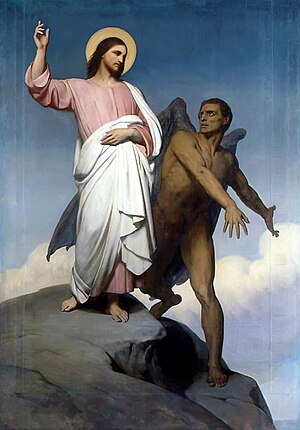
The Temptation of Christ, 1854Image via Wikipedia

Applications from the Temptations of Jesus

(Matt 4:1-11, Heb 2:18, 4:14-16)

Dr. Jay A. Quine

The Challenging Question: “How could Jesus (Who is God) be tempted?”

Hebrews 2:18 and 4:15 argue for our comfort that Jesus was tempted in every way, yet without sin. How is this comforting?

Homer Kent has a different slant on the phrase “tempted yet without sin.” He writes,

“Only in one respect did Christ’s temptation differ from ours. ‘Apart from sin’ (choris hamartias) has been understood by many to describe the result of our Lord’s temptation—that He did not sin. However, the point in the passage does not seem to be whether He sinned or not (of course, He did not), but whether He was truly tempted and thus could really sympathize. It seems better to regard ‘apart from sin’ as naming the only exception in the way Christ was tempted as compared to ordinary men. None of His temptations arose out of a sinful disposition, such as all fallen men have sins Adam. All of Christ’s temptations came to Him from outside Himself (i.e., from Satan). This in no sense violates the truth that Jesus was genuinely tempted, and that He thus understands and sympathizes with men who face such situations.” (Kent, Hebrews)

How can Jesus sympathize with my experience? To answer this question one must look at his temptations.

The first is found in Matthew 4:3 reads, “and when the tempter (dokimazo—tempt with the purpose to destroy) came to him he said, “If you are the Son of God (first class condition, conveys the sense of “since”) command these stones to be made bread.”

Satan knew and admitted who Jesus Christ was—the Son of God. He acknowledged that Jesus is God. It could be translated, “since you are the Son of God,” Satan knew who he was dealing with. The issue in these temptations is not for Jesus to prove to Satan who He is. This Satan conceded.

What is at issue here? The answer is found in the passage as we look at Christ’s responses to Satan’s challenges. Jesus quotes Deuteronomy 8:3. “Man shall not live by bread alone, but by every word that proceeds out of the mouth of God.” Man’s happiness does not depend upon the satisfaction or gratification of desires. The satiation of senses is not the secret to happiness. The key to happiness, and the number one priority for the Christian life, is the WORD OF GOD. The word of God means life, and happiness.

Think of the things Jesus, the Son of God could have done against Satan. But he relied upon the word of God in facing the tempter. The enemy Satan was tempting Christ to take a step outside the plan of God. But Jesus effectively said in this first temptation, “No, I will rely upon the promises of God. I will get my cues of reality, what really will make me happy, from the word of God.” This response is even more clear in the second temptation.

Verse 6

“Since you are the Son of God (again, no issue here) then throw yourself down, for it is written, He shall give his angels charge concerning thee…”

Satan uses against the Lord what Jesus used in his answer to the previous challenge—the word of God. As do the cults today, Satan uses the Scripture out of context, and how it should not be used. In the first temptation Jesus Christ stated that He was going to depend on the Father and the Word of God and not utilize His own ability to turn the stones into bread. Now, Satan essentially says, “Go ahead and depend on God. In fact show your compete faith and trust in the Father and throw yourself down on these stones.” Christ answers, “Do not put the Lord to the test.”

Jesus stated that He was not going to test the Father. So note, in the first temptation Satan tempts Jesus to be independent of the Father’s will or word, and in the second to appear to be dependent upon the Father so as to test His faithfulness by the experience. “Test God, if he is as faithful as he says he is, he won’t let your body break if you jump.” But that is also not how God wants us to live. When we test God this way we put ourselves in a superior position to God—we become the judge of God’s faithfulness.

We say it in slightly more subtle, but similar ways. “God, give me a new job if you love me.” Or, “God, if your promises are true, why does she argue with me all the time.” Or, “God, I hurt. How come I hurt? Didn’t you promise me happiness?” And even in a positive way, “Give me a good day, then I will know you love me.” This is how Satan tempted Jesus.

Third temptation Satan offers Jesus authority to rule over the kingdoms of the world. Satan uses another word for “if” here. It is called the second class condition and communicates the sense of, “If it were true, but it isn’t.” Using this form Satan is saying, “If you will worship me, but you won’t, I will give you the kingdoms of the earth.” Jesus answers Satan by referring to the problem Satan had when he fell—the problem was God’s authority. You can only serve God, and God only is worthy of worship.

Notice also, these temptations from Satan were not to produce evil ends, but to accomplish legitimate ends through evil means. Is it evil for Jesus to eat bread? No, but it is wrong if it means employing Satan’s methods. Is it evil to rely upon and to trust in the promises of God? No, but it is if we put God to the test in doing so. Is it wrong for Jesus to be given all authority, power, and dominion of the world? No. In fact, he has it. But he inherited this position not by capitulating to Satan, but by obeying the will of God by going to the cross, rescuing us from the hold of sin, and rising from the dead and ascending into heaven whereupon the Father said, “All authority is given to you. Sit here until I make your enemies a footstool for your feet.” (Psalm 110)

Applying Christ’s Responses to When You are Tempted

The issue in temptation is the will of God. Will you deviate from God’s will? Was Jesus Christ tempted in this way—yes, more so than we will ever be tempted to do. When was the last time someone said to you, “Get drunk and I will give you a million dollars.” Or, “If you sleep with me, then I will give you a new car.” Such overt and direct temptation doesn’t happen. Satan doesn’t have to tempt us to that degree. All he has to do is say, “Here, get drunk.” And we will—whether we intoxicate ourselves on alcohol or drugs or indulge in the intoxication of pride, or hate, or anger, or rebellion, or some other sin. Satan has to offer us nothing but the sin itself.

Our problem is that we state the question backwards. The question isn’t really, “Does Jesus know what it is like to be tempted and be without sin,” but “Do we know what it is like to be tempted and not sin?” Do we understand what Jesus went through? And the answer is NO! We cannot understand the greater, but He can understand the lesser. Take comfort.

Monday, December 12, 2011

"But I say to you..." Jesus' Sermon on the Mount

Five Antithesis in the Sermon on the Mount

Matthew 5--7

“you have heard”

“but I say”

Explanation / application

Direction of the Law:

“do not commit murder”

“whoever commits murder is liable in court”

“do not be angry”

saying “raca” is enough to be liable in the supreme court; banished to hell.

Be reconciled to another before you present your worship to God. Better to make friends than go to court.

The law spoke to not merely the external but the psycho-sins lying behind the act, such as anger and insults.

“do not commit adultery”

“Whoever divorces his wife, let him give her a certificate of dismissal.”

“do not look…commit adultery in your heart”

“Everyone who divorces his wife makes her commit adultery…”

Be rid of those parts of your body which offend God rather than all of you perish.

Except for the cause of unchastity

The law condemned not only actual acts, but the psycho-sin of lust.

The law allowing divorce supported marriages, not to permit their dissolution.

“do not make false vows, but fulfill your vows to the Lord”

“make no oath at all”

It should be enough that you stand behind your word

The law of oaths was to make your word good, without the need for an outside witness.

“An eye for an eye, a tooth for a tooth”

“do not resist, but turn the other cheek..

“give your shirt and coat… walk two miles… give to him who asks.”

The law instructed Israel’s judiciary for the punishment to fit the crime. The law limited prohibited unmeasured vengeance.

“love your neighbor, and hate your enemy”

“love your enemies”

God’s common grace is a pattern for ethical living.

The Law never allowed for preferential treatment of others.

Please consider supporting this work: